
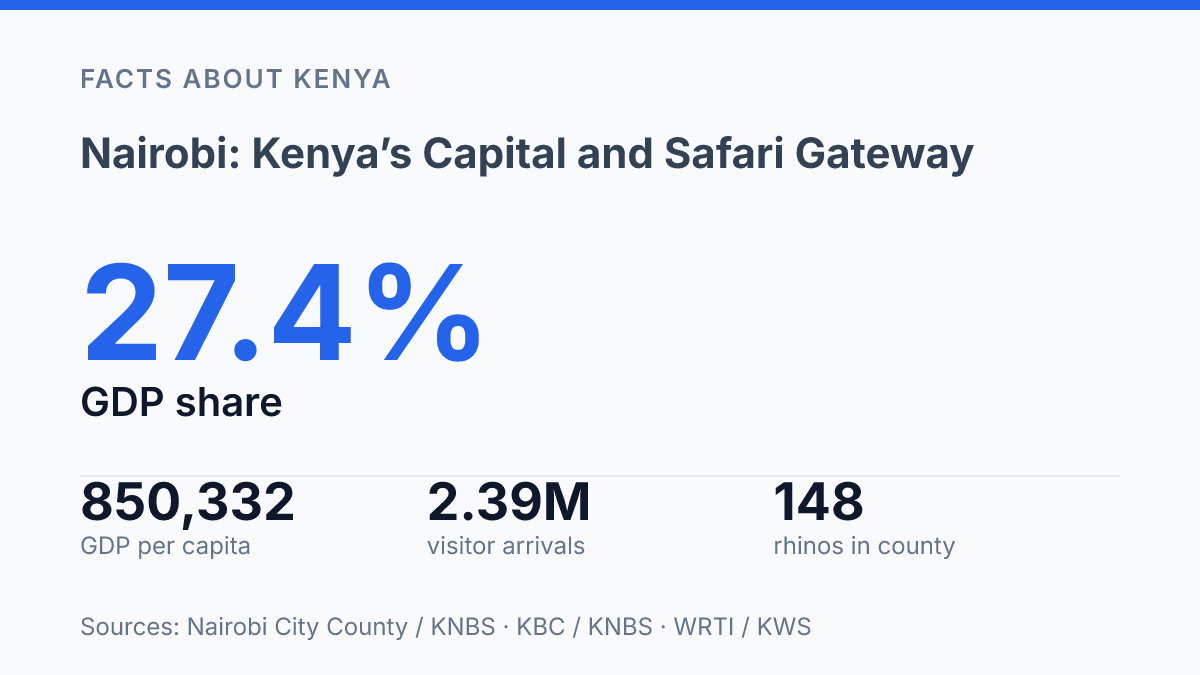
Nairobi generated 27.4% of Kenya’s GDP in 2024, yet lions and rhinos still live about 10 km from its downtown towers.
That contrast is the point. The capital works like Kenya’s control room. It also gives you one of Africa’s strangest first wildlife encounters: protected savanna pressed against office blocks.
The distance is short. The mental shift is not.
Follow that tension through the city’s role in Kenya, the animals inside the park, the pull of the elephant nursery. The airport links that turn one arrival into several possible safaris. Sheldrick Wildlife Trust adds the human detail. Its orphan care makes conservation feel close, not abstract. In my honest opinion, the city’s real power is this mix of money, movement, and wildness in one place.
Why Nairobi sits at the center of Kenya
A railway depot founded in 1899 now produces more than a quarter of Kenya’s economy. Nairobi became the place where government, finance, media, aid agencies, hotels, and regional headquarters crowd into one urban core. That concentration matters when you arrive.
You’re not landing in a side city before the “real” Kenya begins. You’re landing in the country’s command room.
The economic weight is blunt. In 2024, the capital contributed 27.4% of national GDP and had Kenya’s highest gross county product per person at KSh 850,332, according to a county fiscal strategy paper using KNBS GCP data. That means decisions made here ripple into banking, tourism, construction, tech, and trade across the country.
Size changes the feel of a place. The 2019 census put Nairobi County at 4.4 million people, a population larger than many national capitals and big enough to create sharp contrasts from one district to the next. You can move from glass towers and ministries to informal markets and dense residential estates in a short drive.
The city is Kenya’s political center. It doesn’t always behave like a polished capital built for photographs.
It feels louder, more improvised, and more commercially alert than that. In my view, that rough edge is exactly why first-time visitors remember it. The capital doesn’t hide the work of the country behind ceremonial avenues.
Access reinforces its central role. Jomo Kenyatta International Airport is the country’s busiest international gateway, so many visitors meet Kenya through this city before they see the coast, the highlands, or the savanna. That first impression can be messy.
It can also be useful. If you pay attention, the capital tells you how modern Kenya moves, earns, negotiates, and welcomes the world.
What you can see inside Nairobi National Park
A lion can move through open grass with office towers sitting on the horizon. That single view explains why this park feels so improbable. Nairobi National Park was established in 1946, according to the Kenya Wildlife Service.
It still sits only about 10 kilometers from the city center. That closeness sounds like a gimmick until you see wild animals against the edge of a capital city.
The park covers 117 square kilometers, small by national park standards. It carries far more wildlife than its size suggests. Visitors can see black rhinos, lions, giraffes, zebras, buffalo, antelopes, and seasonal plains game moving across open savanna and acacia scrub.
Kenya Wildlife Service records more than 100 animal species here. A short visit can still feel dense with sightings.
Birdlife changes the experience even when the larger animals stay hidden. More than 400 bird species have been recorded in the park, from raptors riding thermals to waterbirds around dams and wetlands.
That number matters because it turns the place into more than a quick wildlife stop. Patient visitors get rewarded even between the headline sightings.
Rhinos give the park its sharper conservation edge. At the end of 2024, Wildlife Research & Training Institute and Kenya Wildlife Service figures recorded 98 black rhinos and 47 southern white rhinos inside the park. The black rhino count had fallen from 118 in 2021, while white rhinos increased from 31 to 47.
The story here isn’t simple success. Protection works. It needs constant pressure.
The strange beauty of the park is also its weakness. Roads, suburbs, aircraft, and city expansion press close to the boundary. That makes the wild setting feel exposed. In my honest opinion, the best thing about this place is also the thing that makes it uneasy: you never forget that the animals are surviving beside a city, not far away from one.
Why the elephant orphanage draws so many visitors
The nursery’s pull is that visitors get just 1 hour, not a whole day, to watch young elephants drink, shove, trumpet, and disappear back behind the rope. That short window runs in the morning, so advance booking matters. Miss it and there isn’t a casual second chance later in the afternoon.
The David Sheldrick Wildlife Trust founded the orphanage’s work in 1977, and its appeal still comes from a simple format. Keepers lead the calves out for feeding and play. Visitors stand close enough to see the mud on their ears and the impatience around the milk bottles.
Those details make the stop feel personal fast. Each calf has a rescue story, usually tied to drought, injury, conflict with people, or a lost mother.
The staff explain those backgrounds without turning the visit into a lecture. That restraint helps. In my humble opinion, the best part is that the experience stays focused on the animals in front of you, not on a polished performance.
The numbers give the emotion some weight. On January 25, 2024, Sheldrick Wildlife Trust said its city nursery cared for 21 orphaned elephants and 2 orphaned rhinos. Its 2025 press kit says the wider program has raised 322 orphaned elephants and 19 orphaned rhinos for return to the wild, with more than 75 calves born to former orphans.
Still, the intimacy comes with a hard edge. The orphanage depends on public interest, donations, and tightly managed access, but rescue work shouldn’t bend too far toward what tourists want to see. The best visits respect that line.
You watch, you listen. You leave when the keepers move the calves back out of view.
Practical details shape the experience more than many visitors expect. The public session runs from 11:00 a.m. to noon by advance booking, with a minimum adult entry donation of US$20, according to Sheldrick Wildlife Trust.
Since September 19, 2023, visitors have also had to pay the national park entry fee. The stop works best when planned rather than added at the last minute.
How Nairobi works as a safari starting point
A safari can begin with a small aircraft at Wilson Airport before breakfast. It can also begin with six dusty hours on a road that looked short on the map.
That split explains why the capital works so well as a launch point. It gives travelers options: road departures, charter flights, scheduled safari hops, hotel pickups, and operators who can reset plans fast when weather or traffic gets awkward.
The best-known route leads toward the Maasai Mara, the reserve many first-time visitors picture when they think of Kenya’s big-cat country. It’s common to start or end that trip in the city because the logistics are already there. You can land, sleep, meet a guide, and move west the next morning without building a complicated chain of transfers.
Southbound trips tell a similar story. Amboseli National Park pairs naturally with the capital, especially for itineraries that want open plains, elephants, and views of Kilimanjaro when the weather cooperates. The route is straightforward on paper, but safari travel is never only about distance. Road repairs, city traffic, rain, and park approach roads all change the feel of a day.
That’s the convenience trap. The city makes safari planning feel easy. The classic wildlife scenes still sit beyond a serious transfer.
For several major parks, a realistic road range is 4 to 6 hours. That can stretch when departure times slip. In my view, this is the detail travelers underestimate most: the capital saves effort, not necessarily time.
Air links soften that tradeoff. Safarilink says it serves 17 destinations from Wilson Airport and carries more than 20,000 passengers per month in peak periods, which shows how much safari movement runs through the city’s smaller aviation hub. Flying costs more.
It protects energy. Driving costs less. It turns the journey into part of the trip.
What Experienced Travelers Plan Before They Land
The smartest move is to treat the capital as part of the safari, not the waiting room before it. Book the nursery early.
Leave room for traffic. Choose your onward flight with care, especially if Wilson Airport is feeding you into a small-plane route.
The next few years will test this balance. Visitor numbers are rising, conservation costs aren’t shrinking, and easy access can still put pressure on fragile places.
In 2025, Safarilink reported peak periods of 20,000+ passengers a month. That tells you where travel demand is heading.
In my humble opinion, the best visitors won’t rush through the city. They’ll notice what it protects before they chase what lies beyond it.
Frequently Asked Questions
Q: Why do people use Nairobi as a starting point for safaris in Kenya?
A: Because Nairobi puts you close to both city services and safari logistics. You can land, sort your trip, and head out without wasting a full day. That convenience matters. The real surprise is that wildlife is already part of the city’s edge.
Q: Can you see wildlife inside Nairobi itself?
A: Yes. Nairobi National Park sits right beside the urban core, and that’s the draw. You can see giraffes, zebras, and lions there, plus endangered black rhinos… all without leaving the city.
Q: What makes Nairobi National Park different from other parks in Kenya?
A: Its location is the big difference. You get a full game reserve next to a capital city, which creates a strange but memorable contrast. In my view, that contrast is what makes the park feel so sharp and so easy to remember.
Q: Is the elephant orphanage in Nairobi worth visiting?
A: Yes, especially if you care about conservation. The David Sheldrick Wildlife Trust runs the orphanage. It gives you a close look at rescued elephants before they’re reintroduced to the wild. It’s not a long stop. It leaves a strong impression.
Q: How many days should I spend in Nairobi before a safari?
A: One to two days is enough for most travelers. That gives you time for the park, the elephant orphanage. A little breathing room before you leave the city. If your main goal is safari, don’t overstay… Nairobi works best as a smart launch point.