
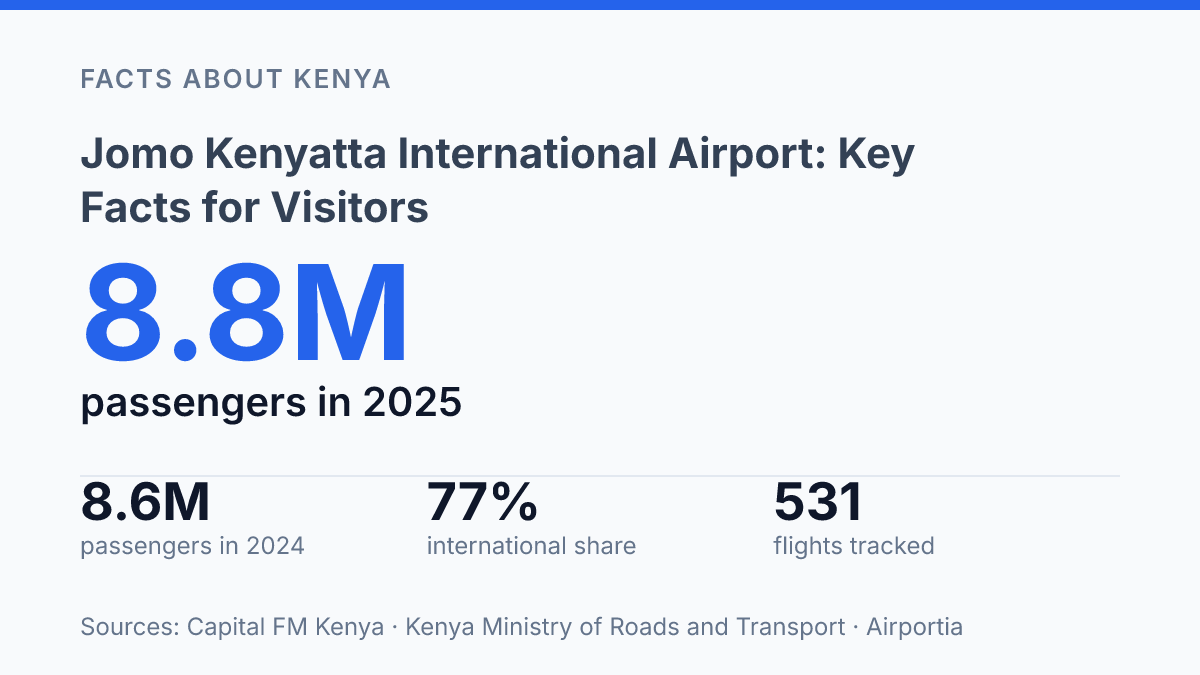
Jomo Kenyatta International Airport handled 8.8 million passengers in 2025, even though its stated annual capacity is 8 million. That gap explains a lot.
The airport works hard. You can feel the strain before you reach the arrivals hall.
JKIA sits in Embakasi, about 18 km southeast of Nairobi’s CBD. That detail matters if you’re comparing it with Wilson Airport, planning a transfer, or wondering why a short distance on the map can still take time on the road.
In my honest opinion, the real story here isn’t just a busy terminal near Nairobi. It’s a hub that sends travelers across 51 countries, carries a heavy international mix, and moves cargo at a scale many visitors never see. The facts below will help you read the airport properly before you land.
Where the airport sits and who it serves
Eighteen kilometres is the airport’s most misleading number.
According to JKIAirport.com, it sits in Embakasi, about 18 kilometres southeast of Nairobi’s CBD, and Wilson Airport is about 17.2 kilometres away from it. That location keeps it practical for trips into central Nairobi. It also puts enough road between you and check-in to make timing matter.
For most overseas arrivals, Jomo Kenyatta International Airport is the first real contact with Nairobi, Kenya’s capital and largest city. It is an international airport, not just a local airfield with a few cross-border flights. The passenger mix proves that point.
In 2024, it handled 8.6 million passengers, according to Kenya’s Ministry of Roads and Transport reporting in the JKIA Integrated Master Plan Final Report. That volume gives the airport a city-scale feel. But it also explains why arrivals, kerbside pickups, and transfer timing can feel less predictable than the distance suggests.
If you’re staying in Westlands, the CBD, Kilimani, or near the national park, the airport’s southeast position shapes your first move. You aren’t choosing only a hotel. You’re choosing how much of Nairobi you want to cross after landing.
In my view, the smartest way to think about the airport is not as “near Nairobi” or “far from Nairobi.” Think of it as close enough to be convenient, but far enough away that traffic can punish tight plans.
How many countries and routes it connects
Airportia’s 2026 route tracker counted 91 routes from Nairobi to 89 cities, a reach that makes the airport much more than a place where visitors simply enter Kenya. The clearest measure is its scheduled international network: regular passenger services connect it with Over 50 countries, not just occasional holiday charters or one-off seasonal movements.
That distinction matters. Scheduled flights create predictable links for meetings, onward travel, medical trips, conferences, family visits, and freight-linked passenger demand.
If you’re transiting through East Africa, reliability often matters more than novelty. A route that operates week after week gives Nairobi a stronger claim as a practical regional hub.
A large route map can look simple on paper. The value of each connection is different. Some routes feed safari and beach tourism.
Others serve government travel, regional headquarters, export businesses, or diaspora movement. A short hop within East Africa can matter as much as a long-haul service if it gets people to the right meeting by morning.
The mix also explains why Nairobi works as a transfer point. Passengers can connect between African cities, Gulf hubs, European gateways, and selected long-haul points without treating Kenya as their final stop. That’s useful.
It also raises expectations. More connections mean tighter schedules, heavier peak-time pressure, and less room for delays.
In my honest opinion, the real strength of JKIA isn’t the number of pins on a route map. It’s the way those scheduled links turn Nairobi into a working crossroads for business, tourism, and regional access.
What travelers should know before arriving
The 18-kilometre ride from the airport to central Nairobi can behave like two completely different trips: quick on a clear road, slow when traffic turns. The location looks convenient on paper.
The real test is the road journey… and that’s where first-time visitors get caught off guard. Build your arrival plan around a range, not a fixed drive time.
International visitors should also expect this airport to feel like Kenya’s front door. According to the Kenya Ministry of Roads and Transport’s Integrated Master Plan Final Report, the airport handled 6.8 million international passengers and 2.0 million domestic passengers in 2024. That means 77% of its passenger traffic was international, so arrival halls can reflect long-haul peaks rather than a steady local rhythm.
Paperwork matters before you fly. Guidance current in 2024 from the Kenya Directorate of Immigration Services says all visitors, including infants and children, must have an approved Electronic Travel Authorisation before travel. The stated processing time is 3 working days, so don’t treat it as a last-minute formality.
Transfer planning needs the same discipline. If you have a hotel check-in, safari pickup, domestic connection, or meeting soon after landing, leave room for immigration, baggage.
The road into the city. In my humble opinion, travelers should treat the city transfer as part of the arrival process, not an afterthought. A short distance can still punish a tight schedule.
Why this airport matters to Kenya’s air links
In 2019, JKIA accounted for almost 70% of Kenya’s total passenger traffic, according to the JKIA Integrated Master Plan Final Report. That share explains why delays, expansions, airline decisions, and route changes here don’t stay local. They ripple across the whole national air system.
This is why the airport is more than Nairobi’s overseas terminal. It is Kenya’s main front door to international air travel, and Nairobi gains from that concentration. So do travelers headed beyond the capital, since long-distance access often starts with a connection through this one airport.
Scheduled service to more than 50 countries gives Kenya something many smaller aviation markets don’t have: direct reach across several regions without forcing every traveler through a foreign hub first. That matters for conferences, tourism, exports, aid work, family travel, and government movement. In my view, what matters most here is not just passenger volume, but how the airport connects Kenya to far more places than most visitors expect.
There’s a catch. The airport with the best global reach isn’t always the most convenient local choice. A traveler moving within Kenya may care more about distance, timing, traffic, or a simpler domestic departure than about access to long-haul flights.
That tradeoff is the point. Local convenience and international reach don’t always line up perfectly.
JKIA wins on global access. That reach comes with heavier demand and more pressure on the airport experience.
Its role also stretches beyond passengers. Business Daily Africa, citing ACI data, reported that the airport handled 363,000 metric tonnes of cargo in 2022. That put it ahead of major African cargo competitors such as Cairo International, OR Tambo, and Addis Ababa Bole for that measure.
For visitors, the practical takeaway is simple: this airport sits at the center of Kenya’s air links because it concentrates international routes, passenger flows, and freight movement in one place. You may feel that concentration as crowds or longer processing times. Kenya feels it as access to the world.
What the pressure at JKIA means for your arrival
Treat JKIA as a working pressure point, not just a pin on your booking confirmation. The planned expansion reported in 2026 could create space for 15 million more passengers. But that won’t help if your eTA is missing or your connection is timed like everything will run perfectly.
Build in slack. Apply for the eTA at least 3 working days ahead, especially if you’re traveling with children. Watch your terminal details, then give Nairobi traffic more respect than your map app suggests.
In my humble opinion, the smartest travelers don’t expect this airport to feel effortless. They prepare for a place that carries a country’s ambitions before breakfast, then get on with the trip.
Frequently Asked Questions
Q: How far is Jomo Kenyatta International Airport from Nairobi city centre?
A: Jomo Kenyatta International Airport is about 18 kilometres southeast of Nairobi city centre. That’s close enough for a straightforward transfer, but traffic can still stretch the trip. Plan a little extra time if you’re landing during rush hour.
Q: What city does Jomo Kenyatta International Airport serve?
A: It serves Nairobi, Kenya’s capital and largest city. That makes it the main airport most visitors use when they’re heading into the city or connecting elsewhere in the country. In my view, if you’re flying into Kenya, this is the airport that matters most.
Q: Which part of Nairobi is the airport in?
A: The airport is in Embakasi, a suburb on the southeast side of Nairobi. That location keeps it close to the city while still leaving room for a major international hub. It’s a practical setup. It does mean your arrival time can depend heavily on road conditions.
Q: How many countries can you fly to from Jomo Kenyatta International Airport?
A: There are scheduled flights to destinations in over 50 countries. That gives you solid international reach, not just a few regional options. It’s a strong network for travelers who need one stop in East Africa.
Q: Is Jomo Kenyatta International Airport the main airport in Kenya?
A: Yes, it’s the main international gateway for Nairobi and a major entry point for the country. If you’re comparing airport options, this is the one most long-haul travelers use. The name is a mouthful. The function is simple: it connects Kenya to a wide set of global destinations.