
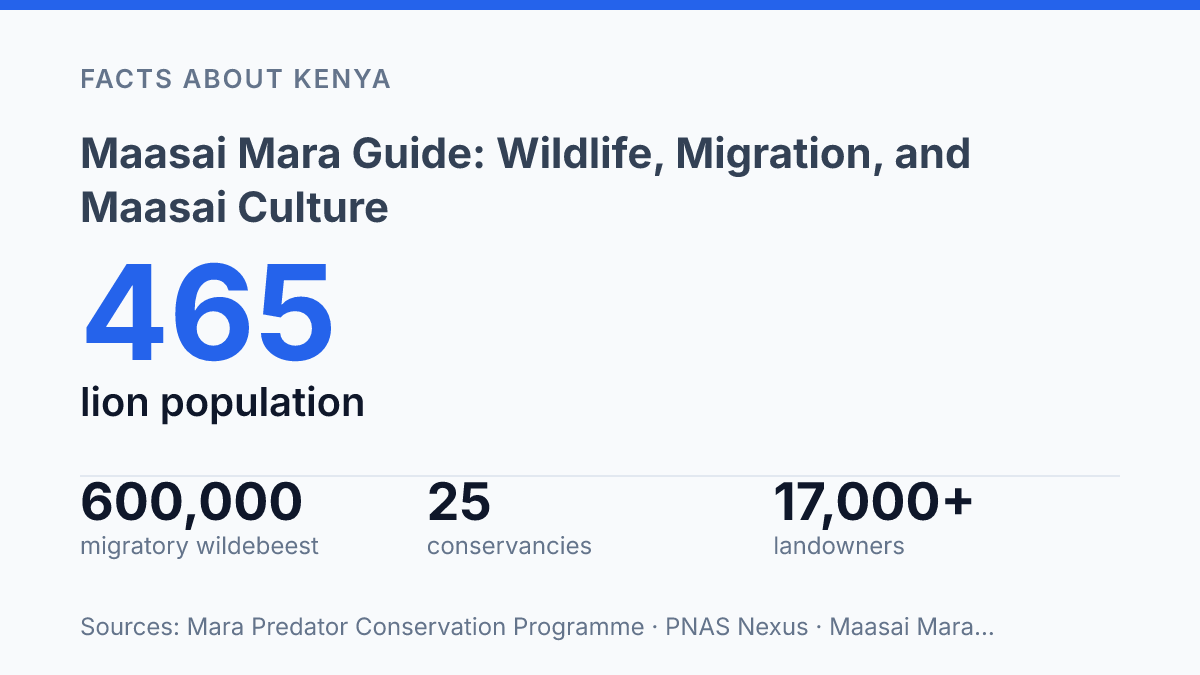
The Maasai Mara most visitors picture as a single reserve is only the center of a much larger Maasai-run conservation system: 25 conservancies now cover 180,000+ hectares around it.
That scale matters. More than 17,000 landowners and 52 tourism partners help fund the space wildlife needs, with lease payments topping US$7 million a year.
The Maasai Mara Wildlife Conservancies Association now plans through 2026-2036. The numbers show both promise and pressure.
Lions look steady. Cheetahs don’t.
Wildebeest still pour through the grasslands, but newer satellite work challenges the old 1.3 million figure that shaped so many safari dreams. Even elephants are teaching researchers that borders mean less to animals than they do to maps.
This guide looks past the postcard version. You’ll see where the reserve fits, why the migration rewrites every visit, and how Maasai communities sit at the center of the story. In my honest opinion, that’s the only honest way to understand the Mara.
Where the reserve sits and what makes it distinct
The reserve’s southern edge is also an international seam: Maasai Mara sits in southwestern Kenya, pressed against Tanzania rather than tucked into Kenya’s interior.
Maps can make that boundary look tidy. On the ground, it feels less like a hard stop and more like part of a wider cross-border ecosystem. Movement, weather, fire, grazing pressure, and tourism patterns don’t obey the line on the map.
Water gives the place its real structure. The Mara River and the Talek River cut through the area, and their presence matters more than a first-time visitor might expect. The Mara River Basin covers 13,834 km², with 65% in Kenya, according to the Maasai Mara National Reserve Management Plan 2023-2032.
Grass does most of the visual work here. The scenery is built from grassy plains and rolling hills, not thick forest or steep mountain walls.
That creates long views, big skies. A sense that everything is laid bare.
But that openness is deceptive. The grasslands look exposed. The rivers and hills decide where animals move and where visitors actually see them.
A ridge can hide a valley from sight. A river bend can turn a plain into a natural route.
In my view, the reserve makes the most sense when you stop treating it as one flat safari postcard. Its character comes from edges: border edges, river edges, hill edges.
The softer edges between protected land and community-managed areas nearby. That mix is why two drives in the same general area can feel so different.
Big cats, elephants, and the animals visitors come for
A lion sighting may fill the camera roll, but zebras and hippos often decide where the day’s drama happens. Big cats get the attention for good reason. Lions hunt in open country, cheetahs work speed and space, and both make every pause in the grass feel loaded.
In 2024, the Mara held an estimated 465 lions over one year old across a 2,713 km² study area, according to the Mara Predator Conservation Programme. That makes lions a realistic hope on a well-planned drive, not a fantasy.
Cheetahs are a different story: the same programme reported resident independent adults falling from 28 in 2023 to 12 in 2024. A sighting carries more weight than many visitors realize.
Elephants change the mood of a drive. They don’t perform like predators. They command space in a way no cat can.
A family group crossing in front of a vehicle can stop everything for 20 minutes. That pause often becomes the memory that lasts.
Zebras bring the system into focus. They feed, move, listen, and scatter in patterns that reveal what predators are doing nearby. In my honest opinion, the best safari guides don’t just point at a cat. They read the grazers first.
Hippos add a different kind of tension. They look slow and half-asleep.
They anchor some of the most active wildlife pockets near water. Birds, crocodiles, grazing animals, and predators all respond to the same wet places, so one quiet pool can become a crowded stage by late afternoon.
Sightings are never spread evenly across the reserve. Dry months pull animals closer to dependable water, and greener periods can scatter grazers across wider feeding areas. That means two visitors can spend the same number of days here and leave with very different stories: one rich in cats, another built around elephants, zebras, and river life.
Why the wildebeest migration changes everything
A migration with no fixed appointment can still decide the busiest weeks of the year. Wildebeest traverse the plains during their annual migration. They don’t move to please lodge calendars or camera crews.
They move when rain has shifted grass, water has opened routes. The herd has to keep feeding.
The journey belongs to the wider Serengeti-Mara ecosystem, not to one reserve. Herds move between Tanzania and Kenya as seasons turn. The spectacle only makes sense when you see it as one connected grazing system.
The border matters to people. It doesn’t matter to wildebeest.
Satellite-based research has also sharpened the old story. A 2025 PNAS Nexus study found fewer than 600,000 migratory wildebeest across more than 4,000 km² in August 2022 and 2023, roughly half the long-repeated 1.3 million figure.
That doesn’t make the migration less powerful. It makes the numbers harder to ignore.
River crossings get the attention, but they’re the least predictable part of the whole event. A herd can gather on a bank for hours, turn away, then cross later when pressure from behind builds. High water, steep banks, predators, noise, and hesitation all change the outcome.
Grazing pressure adds another layer. When thousands of animals feed in one area, the grass disappears fast, and movement becomes a survival decision rather than a scenic parade.
That pressure creates drama. It also exposes how tightly the system depends on rain timing and open movement routes.
This is why the migration changes travel planning. You can choose a season with better odds.
You can’t book a guaranteed crossing on a fixed date. In my humble opinion, the uncertainty is the point: a predictable migration would be easier to sell. It would be far less meaningful to witness.
Maasai villages around the reserve
A visitor can drive from a safari gate to a Maasai enkang in minutes. The two economies can feel centuries apart.
Nearby enkangs are not exhibits inside the protected reserve. They are lived-in settlements on the surrounding land, tied to Maasai families, livestock, schools, churches, markets, and local politics. Some sit close enough to tourist routes that a lodge transfer, cultural visit, or roadside bead stall can bring visitors into contact with them almost by accident.
Cattle still matter here. So do goats and sheep.
The daily work of grazing, water access, and keeping animals safe at night. But tourism has changed the cash flow around many villages.
A household may earn from guiding, camp work, beadwork, lease payments, or transport, even as its identity remains tied to pastoral land and livestock. That mix can be practical. It isn’t simple.
The scale is not small: 25 conservancies spanning more than 180,000 hectares around the national reserve are listed in the Maasai Mara Wildlife Conservancies Association Strategic Plan 2026-, published for 2026 and beyond. That figure matters because it shows how much conservation now depends on land outside the fenced idea of a park, even when the reserve itself remains the name tourists remember.
This is where the neat safari story gets complicated. Wildlife tourism brings jobs and rent.
It can also limit grazing choices, raise expectations, and turn culture into a scheduled stop between game drives. The better visits don’t ask people to perform timelessness.
They ask who owns the land, who gets paid, and how livestock can survive beside tourism. The reserve is defined by animals. The neighboring settlements prove that people have always lived around this protected space, not apart from it. In my view, that human edge makes the place more honest, not less wild.
What the Mara asks of you next
Your best next step is not booking the most famous camp first. Ask who owns the land, who gets paid, and whether the operator supports conservancy leases or community ranger work.
The Maasai Mara rewards that kind of traveler. The hard truth is that beauty here now depends on agreements as much as rainfall.
A 2025 study in PNAS Nexus put migratory wildebeest at fewer than 600,000 across key survey areas, not the familiar 1.3 million repeated for years. That gap should change how you look at every river crossing photo.
Go for the cats, the herds. The villages if you want.
But go with your eyes open. In my humble opinion, the best safari here is not the one that sees the most. It’s the one that understands what keeps the grass open after the vehicles leave.
Frequently Asked Questions
Q: What animals can you see in Maasai Mara?
A: You can expect lions, cheetahs, elephants, zebras, and hippos here. That mix is the draw, but sightings still depend on timing and patience. In my view, the big cats matter most because they turn a good safari into a real one.
Q: When is the wildebeest migration in Maasai Mara?
A: Wildebeest cross the plains during their annual migration, and that’s the event most people plan around. The timing can shift a bit from year to year. You don’t want to treat it like a fixed calendar date. The drama is real. The exact day is never guaranteed.
Q: Where is Maasai Mara located in Kenya?
A: Maasai Mara National Reserve sits in southwestern Kenya, right along the Tanzanian border. That location matters because it connects directly to wider migration routes across the region. The setting feels remote, but it’s still one of East Africa’s best-known wildlife areas.
Q: What is the landscape like in Maasai Mara?
A: The reserve is built on grassy plains and rolling hills, crossed by the Mara and Talek rivers. That mix supports wildlife year-round. The rivers also shape where animals gather. These two rivers are a big reason the area stays so active.
Q: Can you visit Maasai villages near the reserve?
A: Yes, nearby villages called enkangs belong to the Maasai people. Visits can give you a direct look at local culture. They should be respectful and arranged properly. Maasai people have lived with this land for generations. That connection is the point.