
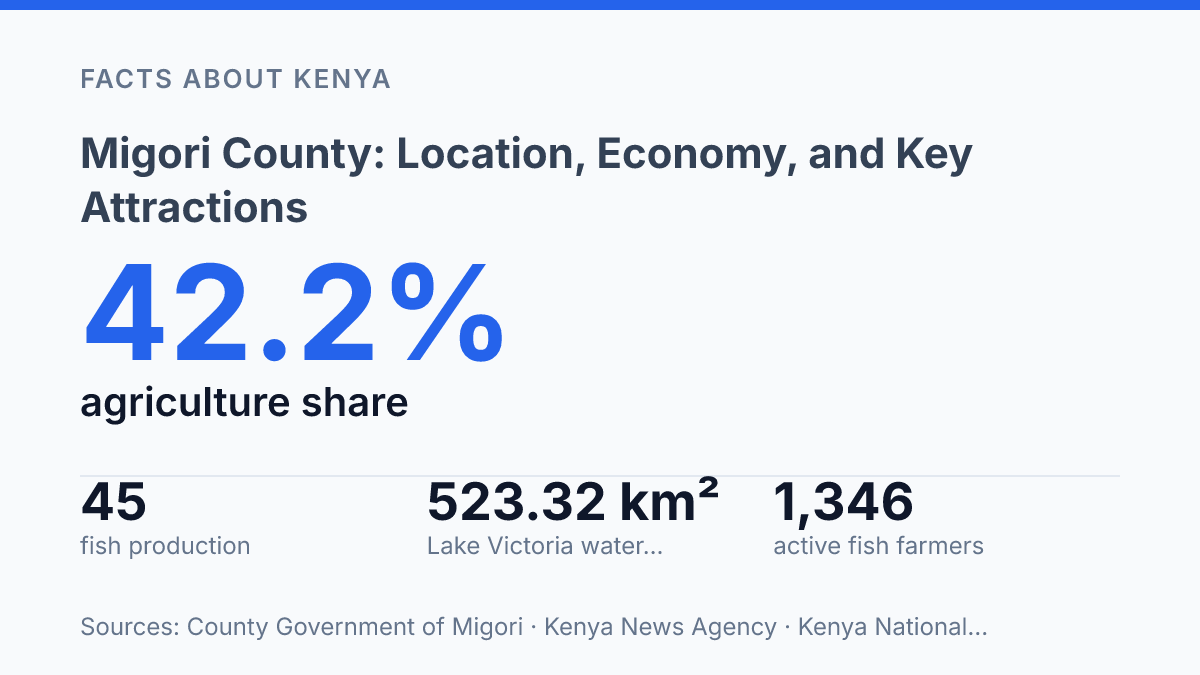
Migori County packs 523.32 km² of Lake Victoria into a 2,596.5 km² county, yet its economy still rests on soil more than water. Agriculture contributes 42.2% of Gross County Product and reaches 71% of households. The county’s daily rhythm starts with farms, boats, cane fields, and markets rather than tourist brochures.
But that familiar rural image misses the pressure points. Fish ponds are expanding fast. Sony Sugar is producing more, even as old machines squeeze efficiency. Gold mining brings income, then danger.
Border traffic at Isebania keeps trade moving. It also draws police attention. And above it all sits Thimlich Ohinga, inscribed by UNESCO in 2018, a stone-built reminder that this place has more depth than most quick county profiles admit. In my honest opinion, that contrast is what makes the county worth reading closely.
Where Migori County sits in western Kenya
Migori County looks compact on the map, but more than 1.1 million residents make its 2,586 km² feel far larger than the outline suggests, according to the Migori County Government. That density is the first clue to why this corner of southwestern Kenya matters. It isn’t just a border area.
It’s a packed county with lake frontage, cross-border contact. A busy urban center anchoring it all.
Its western edge meets Lake Victoria. Its southern line meets Tanzania.
To the north it connects toward Homa Bay, while Kisii and Narok sit on its eastern side. That position gives the county a clear physical identity: lake to one side, international border to another, and inland counties pressing in from the east and north.
In 2026, the Kenya National Bureau of Statistics listed it as County No. 044, covering 2,596.5 km² and including about 523.32 km² of Lake Victoria water surface. That figure sits slightly above the county government’s 2,586 km² land-area figure. The difference doesn’t weaken the picture.
It sharpens it. Migori is measured not only by land, but also by its relationship with the lake.
Migori town is both the county capital and its largest town. That matters more than the label suggests. In a county shaped by edges, the main town gives the administration a clear center of gravity. In my view, this is the detail that makes the county easier to understand: small enough to read quickly on a map, but dense and connected enough to feel much bigger in real life.
Farmers, fishers, and the county’s working economy
A single household here can earn from cane rows, maize plots, tobacco barns. The lake in the same season.
That tells you more about the county’s working economy than any formal business district could. Farming does the heavy lifting, with tobacco, maize, and sugarcane among the major crops grown by local producers.
The numbers back that up. Agriculture contributes 42.2% of Gross County Product and employs 71% of households, according to the County Government of Migori’s CIDP 2023–2027.
This is not an economy led by factories or large industrial parks. It runs on fields, small traders, produce markets, landing sites, and household labor.
Sugarcane gives farmers a cash-crop route, especially around the Awendo sugar belt. It also ties them to mill performance and delayed payment cycles. Maize is more direct.
It feeds homes first, then local markets when harvests allow. Tobacco brings cash too, though it demands careful handling and can lock farmers into input-heavy production.
Fishing adds a second base of income along the shores of Lake Victoria. By June 2024, fish production had reached 45 metric tonnes valued at KSh36 million, up from 22.8 metric tonnes in mid-2023 and 18.2 metric tonnes in 2019, according to Kenya News Agency.
That rise points to more than capture fishing. It shows aquaculture becoming a serious part of local livelihoods.
County fish programmes have also pushed that shift beyond a few early adopters. Kenya News Agency reported 1,346 active fish farmers, 700 rehabilitated ponds, 400 new ponds, 409,000 fingerlings, and 87 tonnes of fish feed supplied across 29 wards. Those are practical interventions, not abstract development talk.
The strength of this model is also its weakness. Land and water spread risk, but households still face dry spells, crop disease, changing lake conditions, and market swings. In my honest opinion, that mix matters because it makes the local economy resilient in ordinary years, yet painfully exposed when nature or prices turn against producers.
Gold mining and the pressure it creates
Gold can put money in a miner’s hand the same day. That same shaft can be closed, flooded, or banned before the next week’s earnings arrive.
Migori has rich gold deposits. They support a mining economy that sits outside the neat language of formal industry. In sub-counties such as Nyatike, small teams dig, crush, wash, and trade ore through local networks.
The work adds income beyond farms and fishing. It rarely comes with steady wages, insurance, or predictable rules.
That is the pull. A farmer may wait months for a harvest. A fisher may lose days to poor catches or bad weather.
Gold offers faster cash, but not certainty. That gap makes it attractive and risky at the same time.
The danger is not abstract. After six miners were killed within two months in Nyatike, Kenya’s Interior Cabinet Secretary banned artisanal and unlicensed commercial gold mining there on 25 March 2024, according to The Star. That response shows the hard tradeoff.
Authorities need to protect lives. A sudden shutdown can also cut off income for households that have few other quick-paying options.
Informal mining also strains land, water, and local administration. Pits can be left open.
Processing sites can sit close to homes or farms. Disputes over claims, buyers, and working groups can move faster than county systems can manage.
There are signs of a push toward safer methods. A UNDP tender published in March 2024 covered equipment for six pilot artisanal and small-scale gold mining sites in Kenya, with two sites in Migori. The aim was tied to mercury-free mining. In my humble opinion, that matters more than polished investment language, because the real test is whether safer practice reaches the people already digging for a living.
Border traffic and the UNESCO site that puts Migori on the map
One road crossing gives Migori a daily rhythm that heritage sites alone rarely create: people, buses, and goods moving toward Tanzania through Isebania. The border point is one of the county’s clearest economic anchors. It serves travelers heading south, traders moving stock, and transport operators who depend on steady cross-border movement.
That movement brings money. It also brings pressure. In March 2024, police intercepted bhang worth KSh9 million near Isebania, according to Kenya News Agency, after other seizures in the same border zone that month.
A busy crossing doesn’t only connect markets. It also tests enforcement, customs control, and local security.
A short distance from that transit story sits something much older. Thimlich Ohinga is a dry-stone settlement and a UNESCO World Heritage Site, inscribed in 2018. UNESCO records the protected property as a 21-hectare site with a wider buffer zone, giving Migori a cultural asset that reaches far beyond road traffic.
Most travelers pass through Migori on the way somewhere else. That’s the irony. Yet Thimlich Ohinga gives the county a deeper identity than buses, border queues, and stopover trade can provide. In my view, that contrast is the most compelling part of Migori’s tourism story.
The county’s position makes it practical and memorable at the same time. Isebania explains why people move through it. Thimlich Ohinga explains why they should pause.
One speaks to present-day mobility. The other preserves an older social and architectural history in stone.
What Migori’s next chapter will test
The next test won’t be whether the county has resources. It does. The harder question is whether those resources can grow without leaving workers, rivers, and border towns to carry the cost.
That means safer mining rules need real enforcement, not paperwork after a collapse. It means fish farming must keep moving from donor-supported ponds into dependable household income. It means Isebania needs trade that feels orderly, even after seizures topped KSh30 million in one month during 2024.
In my humble opinion, the county’s strongest asset is not one sector. It’s the overlap: lake, land, gold, cane, border, and heritage. Handle that mix carelessly.
It becomes strain. Handle it well, and Migori becomes far harder to overlook.
Frequently Asked Questions
Q: Where is Migori County located in Kenya?
A: Migori County sits in southwestern Kenya. It borders Lake Victoria to the west and Tanzania to the south. That location makes it a key gateway for cross-border travel, not just a spot on the map.
Q: What is the main economic activity in Migori County?
A: Agriculture drives most of the local economy. Farmers grow tobacco, maize, and sugarcane, and fishing also supports many households near Lake Victoria. In my view, that mix matters because it gives the county more than one income stream, even if farming still does the heavy lifting.
Q: Is there gold mining in Migori County?
A: Yes. Migori County has rich gold deposits, and artisanal mining is active in places like Nyatike. The work is small-scale. It has a real impact on local livelihoods.
Q: What tourist attractions are in Migori County?
A: Thimlich Ohinga is the standout site. It’s a UNESCO World Heritage Site with a complex stone settlement that draws visitors interested in history and archaeology. The county also gets attention as a transit point for travelers heading to Tanzania through Isebania.
Q: How big is Migori County and what is its population?
A: Migori County covers 2,586 km² and has a population of over 1.1 million people. Its capital and largest town is Migori. That’s a dense population for a county with strong rural and borderland ties…