
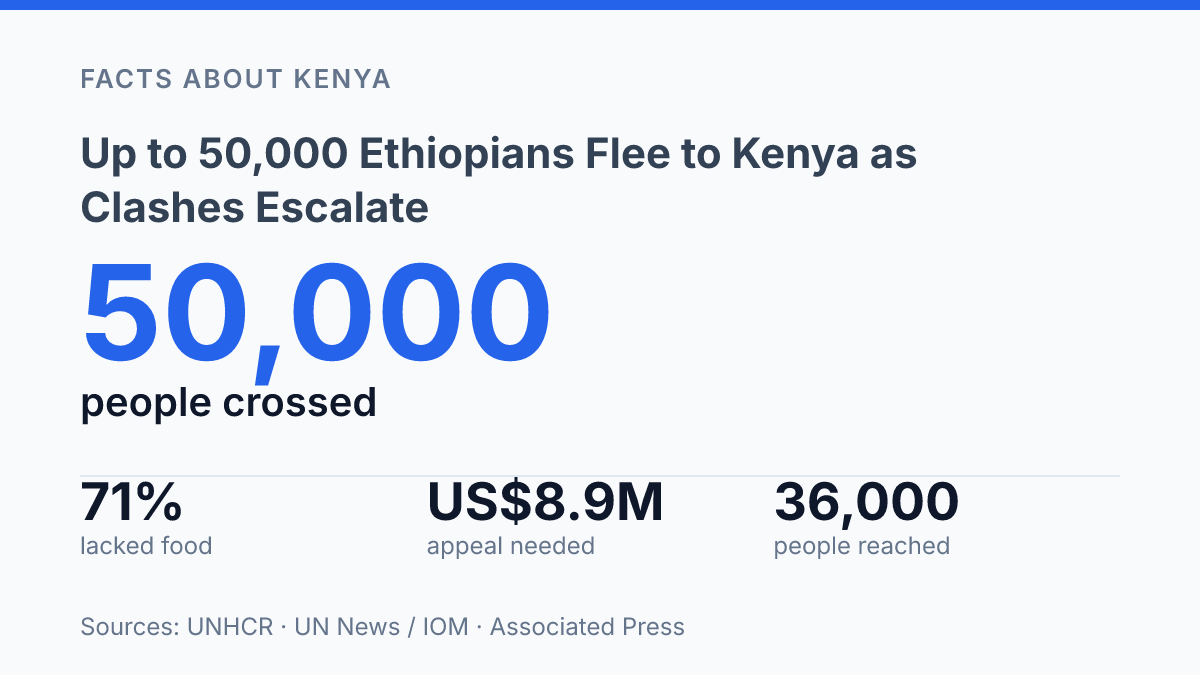
Up to 50,000 Ethiopians Flee to Kenya as Clashes Escalate is no longer only a headline figure: UNHCR said significant movements into Kenya’s Moyale area began after 22 October 2026, and local authorities put arrivals as high as 50,000 six days later. The speed of the movement matters because aid planning was still catching up with a caseload that Associated Press had reported at 36,000 on 27 October, with families sheltering across six camps, villages and host communities.
The crossings are linked to clashes that began on 18 October after violence between Somali regional state police and ethnic Oromo militias in disputed areas around Moyale. This article explains the border routes, the reasons people are leaving, the early UNHCR-led response, and the pressure the influx places on security screening, registration, water, sanitation and child protection.
What is happening at the Moyale border crossing?
Within six days of the first reported crossings, local estimates at the border had risen to the level of a small city. According to UNHCR, significant cross-border movements into Kenya’s Moyale area had been reported since 22 October 2026, and local authorities estimated up to 50,000 people had crossed by 28 October 2026.
Moyale is the main Kenya–Ethiopia border point being watched in this displacement episode because the reported arrivals are concentrated around the town and nearby crossing areas. Associated Press reporting from 22 October identified five entry areas used by people entering Kenya: Sessi, Kore, Biashara, Foundation and Miti. That pattern indicates a rapid movement through several local routes rather than a single formal crossing.
The movement is being treated as displacement linked to clashes on the Ethiopian side of the border, not as routine or general migration. This distinction matters because people arriving after sudden violence are more likely to need immediate safety, temporary shelter, registration and family tracing support. The headline figure signals a major humanitarian event, but it remains an estimate: the caseload may change as monitoring continues, new arrivals are counted and people move between host communities, villages and temporary sites.
Why people are crossing into Kenya
Fighting reignited in five localities around Moyale, turning a nearby international boundary into the quickest route away from immediate danger for many families. According to ACLED’s Ethiopia Peace Observatory, the escalation began on 18 October 2026 after Somali regional state police clashed with ethnic Oromo militias following the opening of a Somali regional office and the raising of a flag in a disputed area. ACLED reported that a 13-year-old Oromo girl was killed, and that violence later flared again in Malab, Chamuk, Bole, Kebele 01 and Waqo Dogo, giving civilians a direct and urgent reason to leave rather than remain in exposed communities.
Safety is the clearest documented motive for the crossings. The available reporting points to flight from violence and insecurity, not onward economic movement or routine travel.
A rapid assessment cited by UN News and IOM found that 96% of surveyed households had fled mainly from Ethiopia’s Oromia and Somali regions, while 9 in 10 said their entire village had fled. That pattern indicates community-wide displacement driven by fear and loss of protection, especially where households judged that staying behind carried greater risk than crossing the frontier.
Geography also explains why Kenya has become the immediate refuge. For people leaving affected areas near the border, Moyale offers the most practical nearby crossing point because it connects communities on both sides and can be reached before longer internal escape routes become viable. The decision to cross is therefore shaped by proximity as much as by nationality: Kenya is not necessarily a planned destination, but the nearest accessible place where civilians can get distance from the clashes.
That immediate safety, however, shifts pressure onto the Kenyan side of the border. Displaced households need shelter, food, water and protection soon after arrival, while host communities and local services must absorb sudden demand. The same assessment found that more than half of arrivals were children, including many under age five, which makes the movement not only a security issue but a protection concern for local responders.
How UNHCR is responding on the border
UNHCR’s first border task is not camp management but verification: identifying who has arrived, where people are staying, and which groups face the highest protection risks. According to the agency, it is closely monitoring the Kenya–Ethiopia border, with attention on arrivals and needs in and around Moyale. That work is central to registration, referral and prioritisation, because population estimates alone do not show whether families have documentation, whether individuals require urgent protection support, or where assistance can be delivered safely.
Assessment work is being carried out through a wider humanitarian information effort rather than by one agency in isolation. A rapid assessment of 758 households cited by UN News and IOM found that 71% lacked enough food, 80% identified food as their most urgent need, and 44% reported insufficient access to drinking water. Those findings are not only welfare indicators; they help agencies understand how shortages can worsen protection risks, particularly where displaced households are scattered across host areas rather than concentrated in a single managed site.
Coordination is also visible in the planning figures released by aid agencies. UNHCR said it was mobilising emergency relief supplies for nearly 12,000 people, while UNHCR, UNICEF, IOM and WFP jointly appealed for US$8.9 million to support a three-month response covering food, shelter, water, sanitation, registration and protection. Monitoring improves the evidence base for such planning, but it does not by itself meet the immediate needs of people who have already crossed; the practical test is whether identified needs are matched by timely resources, safe access and coordinated delivery with Kenyan authorities and humanitarian partners.
What this means for border security and humanitarian aid
Moyale’s immediate administrative challenge is not only the number of people arriving, but the need to manage emergency entry, screening, referrals and aid delivery at the same time. When families cross in rapid succession, border officials, police, county administrators and humanitarian teams must distinguish people needing protection from ordinary cross-border movement, record basic information, identify urgent medical or safeguarding cases, and keep routes open for local commerce and essential services. That combination can stretch systems that are normally designed for regulated movement rather than mass displacement.
Humanitarian logistics are already moving beyond initial monitoring into practical service gaps. Daily Nation reported on 9 November 2026 that OCHA had allocated Sh387 million from the Central Emergency Response Fund for people fleeing into Kenya, while response planning identified needs for 410 additional latrines across four sites, 342 of them at the OMC site, 19,650 litres of water per day in Arosa, and food and nutrition assistance for 9,768 families. Those figures show that the response is not limited to distributing supplies; it also requires sanitation infrastructure, water trucking or supply expansion, nutrition support, and organised site management.
Shelter, food, water and protection are therefore linked operational priorities rather than separate workstreams. Families arriving without stable accommodation need safe places to sleep, but crowded or informal arrangements can increase risks around hygiene, child safety, gender-based violence, and access to information. Protection work in this setting can include registration support, identification of vulnerable people, referral pathways, family tracing where needed, and measures to prevent exploitation during aid distribution.
The number of arrivals could still rise if clashes continue across the border, which makes flexibility central to both security and relief planning. A fast-moving border emergency may require immediate assistance before officials have clear evidence on how long people will remain, whether movement will slow, or whether more households will cross. For Kenya’s local authorities, the near-term task is to keep the border manageable and safe while enabling humanitarian agencies to scale assistance without treating a fluid emergency as a settled population pattern.
What the border response will have to prove next
The decisive measure in Moyale will be whether emergency systems can move from counting arrivals to stabilising them before temporary sites harden into unsafe settlements. The request for US$8.9 million and the CERF allocation reported later by Daily Nation indicate that the response is shifting from first reception to sustained service delivery.
That shift carries practical tests: registration must be accurate enough to protect families without delaying access, security screening must not obstruct asylum procedures, and infrastructure targets such as hundreds of extra latrines and daily water trucking must match population growth. If clashes persist across the border, Kenya’s Moyale area may become less a transit point than a protracted humanitarian front.
Frequently Asked Questions
Q: Why are Ethiopians crossing into Kenya right now?
A: People are crossing the border because ongoing clashes on the Ethiopian side have made their areas unsafe. Many are seeking immediate protection and basic security in Kenya. The movement has been occurring since 22 October.
Q: How many people have fled into Kenya so far?
A: The figure reported is up to 50,000 Ethiopians. This is an upper estimate, which means the exact number may be lower. It still indicates a large population movement in a short period.
Q: Which border area is affected by the influx?
A: The main area being monitored is the Kenya–Ethiopia border in Moyale. This border crossing has become a focal point because it is one of the nearest routes for people escaping the clashes. Monitoring there helps authorities track arrivals and humanitarian needs.
Q: What is the UNHCR doing about the situation?
A: The UN Refugee Agency, or UNHCR, is closely monitoring the situation on the border. That role typically involves tracking arrivals, assessing protection needs, and coordinating with local authorities and aid partners. The focus is on understanding how many people are arriving and what support may be required.
Q: When did the displacement into Kenya begin?
A: The reported cross-border movement began on 22 October. Since then, clashes on the Ethiopian side have continued to push people toward Kenya. The date matters because it shows the displacement has been ongoing rather than a one-day event.