
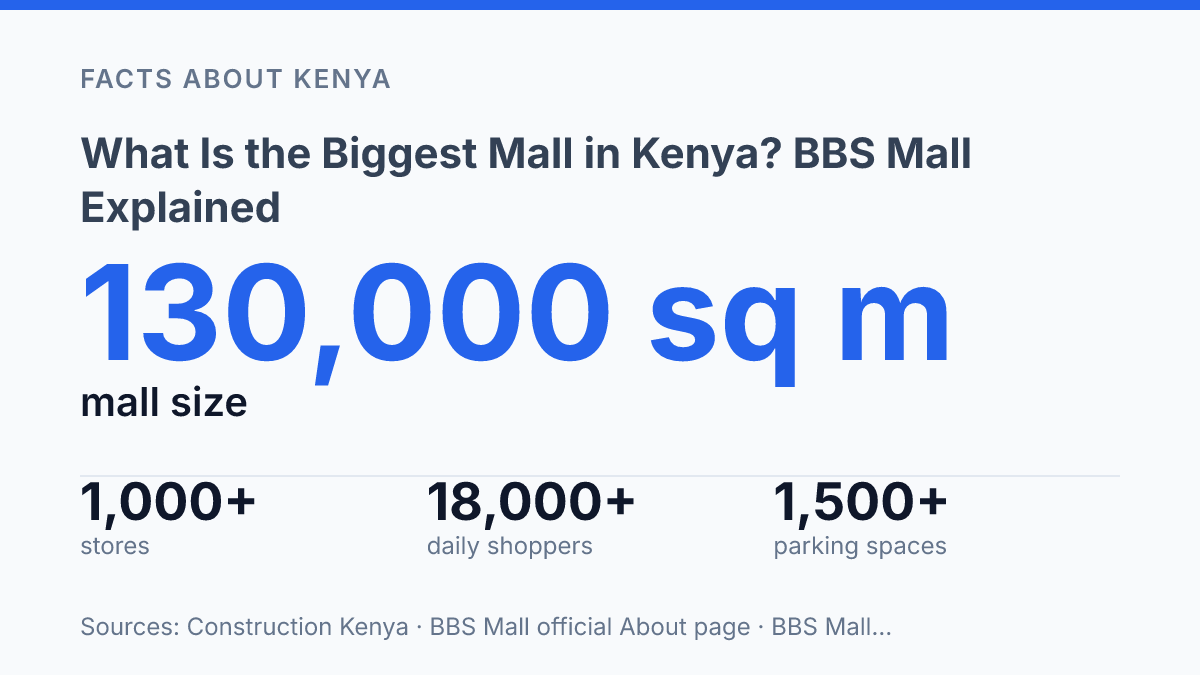
What is the biggest mall in Kenya? Not the one many Nairobi shoppers guess first: Business Bay Square in Eastleigh makes the strongest retail-mall claim with 130,000 sq m of built space and more than 1,000 stores under one roof.
That scale changes the conversation. BBS opened to the public in 2023. It already pulls reported daily footfall of over 18,000 shoppers.
It also sits in Eastleigh, not the usual upmarket mall corridor. That contrast matters.
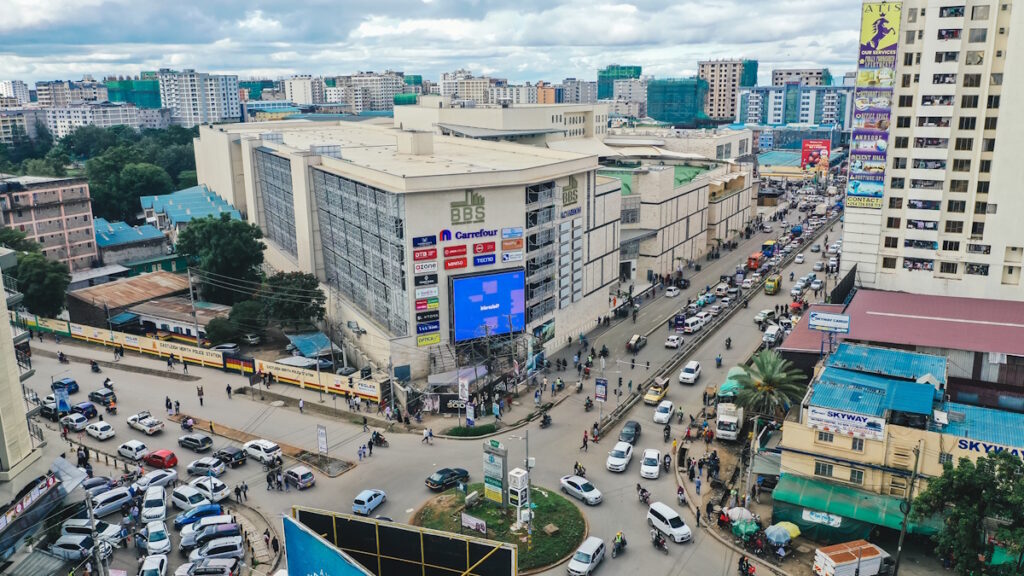
The catch is the word “biggest.” If you mean dense retail space, BBS leads. If you mean a wider lifestyle development, Two Rivers enters the fight with its 102-acre precinct. In my honest opinion, that’s where most casual answers go wrong: they compare a mall to a whole mixed-use district, then act surprised when the numbers don’t line up.
Business Bay Square Mall holds the top spot
A mall with about 3,500 shops changes the meaning of “biggest” from square footage to sheer retail density. If you’re asking What is the biggest mall in Kenya?, the clearest answer by number of retail outlets is Business Bay Square (BBS) Mall in Eastleigh, Nairobi.
That outlet count is what sets BBS apart. Most Kenyan malls feel large because they spread supermarkets, cinemas, restaurants, offices, and parking across broad sites. BBS feels different.
It stacks an unusually high number of small and mid-sized traders into one commercial complex. The scale shows up in choice, foot traffic. The number of businesses operating under one roof.
The current reference point matters. As of 2024, recent coverage and mall profiles placed BBS at the top when the ranking is based on retail-shop capacity rather than land size. The mall also sits on 6.4 acres in Eastleigh, a dense trading district already known for high-volume commerce.
There’s a catch, though. BBS wins on outlet count. That doesn’t automatically make it Kenya’s largest property by land area or the country’s biggest mixed-use development.
Those are different measurements. A sprawling lifestyle precinct can cover more acres, yet still have fewer individual shops than BBS.
In my view, Outlet count is the most useful answer for ordinary shoppers, because it tells you where the widest concentration of retail activity actually is. If you want the mall with the most shopfronts and the strongest market-style density in a formal complex, BBS is the name to remember.
Why BBS Mall outpaces other major malls
A mall can dominate the retail race and still lose the acreage contest by more than fifteen times.
That’s the cleanest way to understand BBS against Two Rivers Mall in Ruaka. Two Rivers has earned its reputation as a large lifestyle hub, with 100+ acres giving it the kind of room that suits hotels, offices, entertainment, leisure space, and broader mixed-use planning.
BBS wins on a different logic. According to Construction Kenya, BBS Mall carries a headline size of 130,000 sq m, sits on 6.4 acres, targets an 85% built-up area, and opened to the public in 2023.
That last detail matters. BBS is not spreading out like a destination estate. It’s stacking retail activity into a tighter urban footprint. In my honest opinion, that density is the real reason the mall feels larger in commercial terms than sites with far more land around them.
The tension is simple: “biggest” changes shape the moment you change the ruler. Land area favors mixed-use developments like Two Rivers.
Retail intensity favors BBS. Total precinct scale, shop concentration, and usable mall space don’t measure the same thing.
That’s why BBS can credibly attach itself to the wider East and Central Africa claim for shopping-complex scale, even though Two Rivers remains the better example of a sprawling lifestyle development. One is a concentrated retail machine.
The other is a broad destination project. Confusing the two is where most comparisons go wrong.
What you’ll find inside BBS Mall
You can visit a doctor, withdraw cash, eat lunch, and shop for household goods without leaving the same complex. That’s the real reason Business Bay Square Mall feels larger than a normal retail building. It works less like a single mall trip and more like a full-day commercial stop.
The medical side is a major clue. BBS’s official About page in 2025 says the complex includes hospitals offering immediate and inpatient services. That changes the rhythm of the place.
People don’t only come to browse. Some come for urgent care, appointments, follow-ups, or family support.
Banks and food outlets deepen that pattern. The mall’s own materials list banking facilities on site, along with over 30 restaurants, so visitors can handle money, meet clients, eat, and move back into trade without crossing town. In my humble opinion, that mix matters more than a polished tenant list, because it shows how the building actually gets used.
Its Eastleigh, Nairobi address also does heavy work. Eastleigh is one of the city’s strongest trading zones, with wholesalers, importers, transport operators, and everyday shoppers moving through the area all day.
Kenyans.co.ke reported in 2024 that the mall is roughly 7–10 minutes from Nairobi CBD, depending on transport mode. That short link gives it reach beyond the neighbourhood.
There’s a tradeoff, though. The same breadth that makes BBS useful also makes it harder to label cleanly.
It’s not just a shopping stop, but calling it only a hospital-linked service centre misses the retail pull. The better reading is this: BBS sits at the point where mall, service hub, and commercial centre start to overlap.
Why the answer changes if you change the metric
BBS can be Kenya’s biggest shopping complex by tenant count and still lose the footprint contest. That contradiction is the whole reason the question keeps coming back.
If biggest means the highest number of separate retail outlets, BBS Mall is the clean answer. This measure rewards density. It asks how many shopfronts, service counters, food spots, and daily retail options sit inside one commercial complex. In my view, this is the answer most shoppers actually mean, since they care about choice more than boundary lines on a site plan.
Change the metric, though. The answer shifts.
For land area and broader development scale, Two Rivers Development is the better example of a sprawling mixed-use development. Centum Real Estate’s 2024 brochure describes permission for up to 1.5 million sq m of total development, with the mall anchored by 67,000 sq m of retail space and 21,000 sq m of office space.
That doesn’t make one answer false. It means the word biggest is doing too much work. A dense retail complex can feel enormous once you’re inside it.
A mixed-use estate feels large before you even reach the mall doors. One measures retail intensity. The other measures urban scale.
So the precise answer depends on what you’re comparing. Use BBS Mall when the question is about shop count and retail concentration. Use Two Rivers Mall when the question is really about a larger lifestyle precinct spread across a wider development.
Say the metric out loud. The confusion disappears.
Why the measuring stick matters more than the mall name
The next mall ranking in Kenya won’t be settled by a prettier atrium or a louder launch. It’ll be settled by the measuring stick.
Two Rivers still has the stronger case as a broader precinct, and BBS has the sharper case as a retail-heavy shopping complex. That distinction will matter more as Nairobi absorbs space. Cytonn reported 3.6 million sq ft of retail oversupply in the metro area in 2024, so bigger doesn’t always mean healthier.
If you’re comparing malls, ask one question first: are you counting retail floor area, total development land, number of shops, or visitor pull? In my humble opinion, the honest answer is less neat, but it’s far more useful. In Kenya’s mall race, the winner changes when the ruler changes.
Frequently Asked Questions
Q: What is the biggest mall in Kenya?
A: Business Bay Square, or BBS Mall, is the biggest mall in Kenya. It sits in Eastleigh, Nairobi, on 6.4 acres. It packs in over 3,500 shops alongside hospitals, banks, and restaurants. That scale matters… but the real surprise is how many retail outlets it fits into one place.
Q: Is BBS Mall bigger than Two Rivers Mall?
A: Yes, if you mean the number of retail outlets. BBS Mall has more shops, while Two Rivers Mall in Ruaka is the larger mixed-use lifestyle development, stretching over 100 acres. They win on different measures. The “biggest” label depends on what you’re comparing.
Q: Where is BBS Mall located in Nairobi?
A: BBS Mall is in Eastleigh, one of Nairobi’s busiest commercial areas. That location helps explain why it draws such heavy foot traffic and retail activity. In my view, it’s the right place for a mall built around volume, speed, and constant turnover.
Q: How many shops are inside BBS Mall?
A: BBS Mall has over 3,500 shops. That’s not a small upgrade from a typical mall. It puts the complex in a different class entirely. You’ll also find banks, hospitals, and restaurants. It functions like a full commercial hub, not just a shopping center.
Q: Why do people call BBS Mall the largest shopping complex in East and Central Africa?
A: They call it that because of its sheer retail count and the range of services inside one development. The mall combines shopping with health, banking, and food services, which pushes it beyond a normal retail center. The size gets the headline. The density is what makes it stand out.