
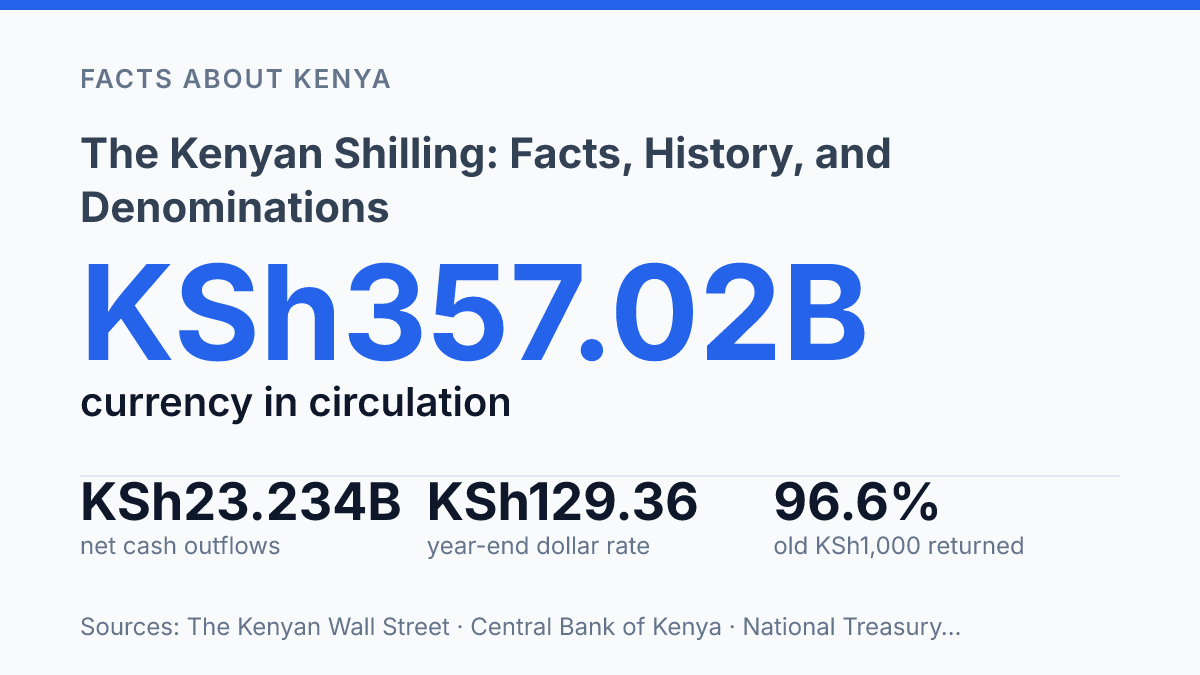
The Kenyan shilling had KSh357.02 billion in circulation in FY 2024/25, yet its smallest legal rules still reach down to cents most people never handle. That contrast is the point: money can feel ordinary at the kiosk, then become highly technical the moment law, security threads, or exchange rates enter the picture.
Kenya defines the shilling as 100 cents, with 20 shillings making one Kenya pound for accounting purposes. The Central Bank of Kenya controls legal-tender notes and coins, not commercial banks or mobile-money platforms. In my honest opinion, that legal monopoly matters more than the designs on the notes.
In August 2024, CBK released new KSh50 to KSh1,000 banknotes with colour-changing security threads. This guide follows the money from the 1966 launch to demonetisation, daily payments, and trade pressure, without treating a banknote as just a printed piece of paper.
What the currency is and how it’s divided
A one-shilling coin can decide whether a market price rounds up, even though Kenya’s money is formally split into cents. The Kenyan shilling is the official currency of Kenya. It works as the basic unit for prices, wages, fares, taxes, bills, and cash payments across the country.
The unit is divided into 100 cents. That structure looks neat on paper, but daily buying rarely feels that tidy. Many small purchases depend on whole shillings, especially in markets, kiosks, public transport, and cash-heavy neighbourhood shops where rounding can change what you actually pay.
Kenya’s currency unit is the Kenya shilling, divided into 100 cents, and 20 shillings equal one Kenya pound. Monetary obligations are treated as payable in Kenyan currency unless the law or the parties say otherwise, according to the Kenya Law, 2024 version of the Central Bank of Kenya Act.
That last detail matters less at the vegetable stall than in contracts, invoices, and formal accounts. It shows how the unit anchors both casual and official payments.
In everyday circulation, people commonly handle 1, 5, 10, and 20 shilling coins, plus 50, 100, 200, 500, and 1,000 shilling banknotes. The split is practical.
Coins cover low-value change and quick local purchases. Notes handle supermarket baskets, fuel, school costs, rent deposits, and higher-value cash transactions.
The surprise is how much the smallest values still matter. A few shillings may look minor beside a 1,000 note. They shape bargaining, fare collection, and exact change. In my view, that’s where the currency feels most real: not in the largest note, but in the coin someone insists on getting back.
Who controls printing and minting
A Kenyan banknote is born from a statute, not from a printer’s schedule.
Under the Central Bank of Kenya Act, Cap 491, the Central Bank of Kenya holds the authority behind Kenya’s notes and coins. That means the institution decides what legal cash enters circulation, what designs and security features appear on it, and when older issues should be replaced or withdrawn. Private printers may handle production under contract.
They don’t control the money supply. The legal power sits with the central bank.
That distinction matters. Issuing currency is the physical side of the job: notes, coins, release, replacement, withdrawal, and anti-counterfeit controls. Regulating monetary policy is different.
That work deals with money conditions in the economy, such as interest rates and liquidity. The two functions touch, but they’re not the same thing.
You can see the production role in recent updates. In August 2024, CBK released a new banknote series covering the KSh50, KSh100, KSh200, KSh500, and KSh1,000 notes, with the 2024 year of print and new colour-changing security threads, according to the Central Bank of Kenya Annual Report & Financial Statements 2024/25. That is currency management in plain sight: the state refreshing physical money so people and businesses can trust what they handle.
Cash still moves in large amounts, too. In FY 2024/25, CBK recorded currency withdrawals of KSh499.56 billion against deposits of KSh476.32 billion, creating net cash outflows of KSh23.234 billion into circulation, according to the same annual report. That gap shows demand for physical money didn’t vanish, even as digital payments grew.
But state control has limits. The government can decide what official cash looks like and which notes count as legal tender.
It can’t simply order the shilling to hold a certain real-world value. Trade flows, prices, borrowing costs, market confidence, and foreign exchange demand all push back. In my honest opinion, that’s the key detail people miss when they talk about currency control.
How Kenya’s money system changed over time
Kenya waited nearly three years after independence before putting a fully national currency issue into circulation. The older East African shilling did not disappear overnight. It remained part of the region’s shared monetary inheritance after 1963, then gave way as Kenya built institutions that matched its new sovereignty.
The handover became concrete on July 1, 1966. Under Legal Notice 252, according to CBK’s 2023 account of Kenya’s demonetisation experience, the first CBK-issued shilling currency entered use. That first issue included banknotes in 5, 10, 20, and 100 shillings, plus coins in 5, 10, 25, and 50 cents and 1 shilling.
That shift mattered because it moved currency from a regional arrangement into national control. The Central Bank of Kenya became the institution that could retire older money, introduce new issues, and decide when cash no longer met the country’s security needs.
This was not just a branding exercise. It changed who stood behind the note in your hand.
Redesigns have carried that same message ever since. A new note can project order, confidence, and technical strength.
It can also reveal a harder truth: cash depends on public trust. That trust has to be renewed. In my humble opinion, that’s the part of currency history people tend to underplay.
The clearest modern example came in 2019, when Kenya withdrew the old KSh1,000 note from circulation. CBK later reported that 209,661,000 old notes were returned, equal to 96.6% of those in circulation. Another 7,386,000 notes, worth KSh7.386 billion, became worthless.
That episode showed the power of a central issuer, but also the pressure behind the decision. Currency history is not only about new designs. Sometimes it is about forcing a clean break.
Why the shilling matters in daily life and trade
In 2024, the shilling moved from KSh159.69 to KSh129.36 per US dollar, a shift that changed the cost base for importers before most shoppers saw it on shelves. The National Treasury also reported inflation easing from 7.7% in 2023 to 4.5% in 2024. That matters at the till.
The relief doesn’t land evenly. Fuel, wheat, cooking oil, medicine, and spare parts all move through different supply chains.
Households feel the currency through ordinary decisions. A salary is paid in shillings, rent is quoted in shillings. A monthly food budget either stretches or snaps in shillings.
That’s why exchange-rate headlines aren’t abstract. They show up later as fare changes, school-fee pressure, or a smaller basket at the market.
Traders feel the same pressure at a larger scale. Kenya buys and sells across borders with Uganda, Tanzania, and Rwanda. The shilling sits inside daily pricing talks for transport, produce, fuel, building materials, and manufactured goods.
A Kenyan exporter wants a stable local return. A regional buyer wants a fair conversion. Both sides can agree on the goods and still argue over the rate.
Digital payments changed the feel of money in Kenya. They didn’t make the currency less central. M-Pesa and bank transfers let people pay rent, split bills, settle suppliers, and send wages without handling notes. Still, the amount is counted in shillings.
The rails changed. The unit did not.
Cash keeps its place for reasons that aren’t sentimental. Small vendors may prefer it for speed, rural buyers may need it where agent float is thin, and some transactions still work best when the payment is final in the hand. According to The Kenyan Wall Street, citing CBK annual data, currency in circulation reached KSh357.02 billion in FY 2024/25, with banknotes making up most of that stock.
The contrast is the real story. Kenya can move quickly toward mobile payments and still depend on physical money every day. In my view, that’s the clearest proof that a currency is bigger than the paper, coins, apps, and accounts used to move it. Cash settles.
Mobile money records. Both keep the shilling at the centre of daily trade.
What the next note change will reveal
Money works best when nobody thinks about it, but Kenya’s recent history shows how much work that calm takes. The Central Bank of Kenya can redesign a note, retire a denomination, or tighten security features. The effect reaches market stalls before it reaches policy papers.
The lesson from 2019 is blunt. Even when 96.6% of old KSh1,000 notes came back, billions still died in drawers, safes, and forgotten cash boxes. In my humble opinion, treat every currency notice as personal finance news, not background noise.
If you handle cash, travel, trade, or price goods in Kenya, watch the shilling as a living system. The note in your hand is never just payment.
It’s a deadline, a rule. A signal.
Frequently Asked Questions
Q: What currency is used in Kenya?
A: Kenya uses the Kenyan shilling. It’s the country’s official currency, and it’s divided into 100 cents. Kenya is the key country here, 100 cents is the split that matters, and The Central Bank of Kenya Act cap 491 set the legal basis for printing and minting it.
Q: How many cents are in one Kenyan shilling?
A: One Kenyan shilling equals 100 cents. That simple split makes cash math easy, even if coin use has changed over time. 100 cents is the number to remember, the Kenyan shilling is the unit, and The Central Bank of Kenya Act cap 491 is the law tied to its production.
Q: Who issues the Kenyan currency?
A: The Central Bank of Kenya is responsible for printing and minting the currency under the law. That authority comes from The Central Bank of Kenya Act cap 491. Central Bank of Kenya is the institution, cap 491 is the legal reference, and the Kenyan shilling is the currency it manages.
Q: When was the Kenyan shilling introduced?
A: The Kenyan shilling replaced older currency arrangements after independence. The exact introduction date depends on whether you’re asking about the first issue or later redesigns. What matters most is that it became Kenya’s national currency and stayed that way. In my view, that continuity matters more than the date trivia for most people.
Q: What denominations does the Kenyan shilling come in?
A: The Kenyan shilling exists in both notes and coins, though the mix has changed over time. Some denominations are used more in everyday payments, while others show up less often. That’s normal… cash systems shift. The currency unit stays the same.